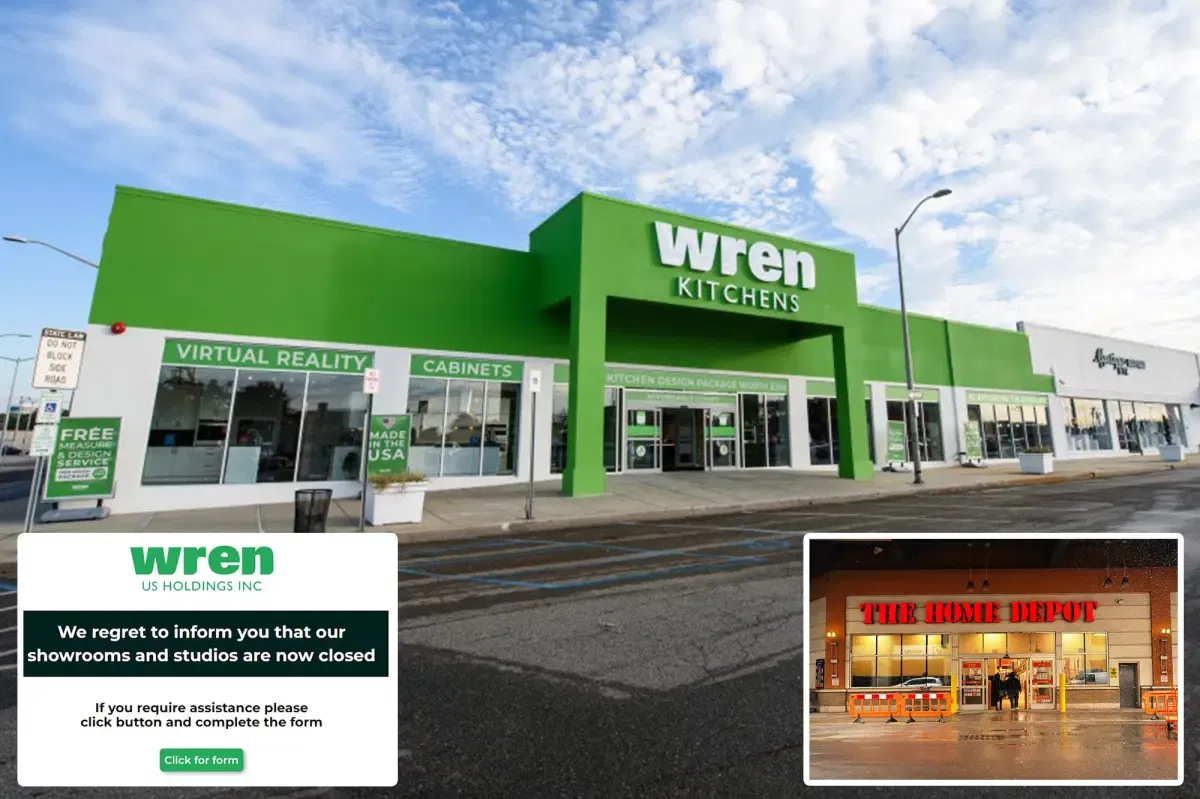
When a company that listed between $100 million and $500 million in assets vanishes from the US market overnight, investors should pay close attention. That's exactly what happened last week when Wren Kitchens, a UK-based kitchen design and remodeling company, abruptly shuttered all 15 of its American showrooms on April 23 and filed for Chapter 7 bankruptcy liquidation in the District of Delaware bankruptcy court the following day.
The sudden collapse of Wren US Holdings Inc. — the entity behind the stateside operations — sent shockwaves through the home improvement industry and left hundreds of customers with unfinished renovations and thousands of dollars in deposits at risk. For investors, the story offers a stark reminder of how quickly ambitious expansion plans can unravel, and what signals to watch before they do.
How the Wren Kitchens US Collapse Unfolded: From Home Depot Partnership to Chapter 7 Liquidation
Wren Kitchens entered the US market approximately five years ago with grand ambitions, opening a network of 15 showrooms primarily along the East Coast. The company's biggest strategic move came in 2024 when it launched a partnership with Home Depot, establishing "Wren Kitchen Studios" inside several Home Depot locations. This partnership was meant to give Wren access to Home Depot's massive customer base while offering Home Depot shoppers a premium kitchen remodeling option.
But the expansion proved far more costly than anticipated. On April 23, 2026, employees arrived at work to find the doors locked. All 15 showrooms — both standalone locations and those inside Home Depot — were closed immediately. The next day, the company filed for Chapter 7 bankruptcy, triggering a complete liquidation of its US assets.
Home Depot acknowledged the closure in a statement, telling multiple outlets: "Wren Kitchens has alerted us that they've ceased operations in the United States, which includes closing their showrooms in our stores." The abrupt nature of the shutdown left even the company's largest partner scrambling for answers.
Timeline: How Wren Kitchens' American Dream Unraveled in Just Days
2021: Wren Kitchens enters the US market, opening its first showrooms on the East Coast with plans to challenge Home Depot and Lowe's in the kitchen remodeling space.
2024: Wren Kitchens announces a strategic partnership with Home Depot to open in-store Wren Kitchen Studios, gaining access to millions of potential customers.
April 23, 2026: Wren Kitchens abruptly closes all 15 US showrooms and lays off all American employees without prior notice.
April 24, 2026: Wren US Holdings Inc. files for Chapter 7 bankruptcy in the US Bankruptcy Court for the District of Delaware, listing between $100 million and $500 million in assets.
April 27-28, 2026: News of the bankruptcy spreads, with affected customers and employees speaking out. A proposed class action complaint is filed alleging violations of the Worker Adjustment and Retraining Notification (WARN) Act, which requires 60 days' notice for mass layoffs.
The speed of the collapse is notable. Unlike Chapter 11 bankruptcy — which companies like Bed Bath & Beyond and Rite Aid have used to restructure debts while continuing operations — Chapter 7 is a complete termination of business. A trustee will be appointed to liquidate all assets and distribute proceeds to creditors.
Why the Wren Kitchens Bankruptcy Matters: Expert Analysis and Investor Implications
The Wren Kitchens failure offers several critical lessons for investors watching the retail and home improvement sectors.
Partnership risk is real. Home Depot investors should note that even a well-executed partnership with a retail giant does not guarantee success. "Wren Kitchens had access to Home Depot's foot traffic and brand credibility," said analysts covering the home improvement sector. "But if the underlying business model wasn't sustainable, even that partnership couldn't save them."
Chapter 7 vs. Chapter 11 matters enormously. For customers and creditors, the distinction is painful. In Chapter 7, unsecured creditors — including customers who paid deposits — are at the back of the line for repayment. Secured creditors, bankruptcy administrative costs, and tax authorities get paid first. Industry experts cited by Farrell Fritz in a Newsday report noted that because this is a Chapter 7 filing and not a Chapter 11 reorganization, the likelihood of customers recovering deposits is extremely low.
International expansion carries hidden risks. UK-based companies expanding into the US market face a fundamentally different regulatory, competitive, and consumer landscape. The cost structure, supply chain logistics, and marketing requirements can differ dramatically from the home market.
Cash burn rates deserve scrutiny. The rapid shutdown suggests Wren's US operations were burning through cash faster than anticipated. For investors evaluating any retail expansion story, the rate at which a company is consuming cash relative to its revenue growth is often a more telling metric than top-line growth alone.
Employee treatment matters for reputational risk. The potential WARN Act class action highlights how bankruptcy proceedings can generate secondary legal liabilities. Companies that abruptly shutter operations often face months or years of litigation, which can erode whatever value remains for creditors.
Where Things Stand Now: Latest on the Wren Kitchens Chapter 7 Case
As of this week, the Chapter 7 case is in its early stages. A bankruptcy trustee is expected to be appointed to oversee the liquidation of Wren US Holdings Inc.'s assets. The company's showroom fixtures, inventory, equipment, and any intellectual property will be sold, with proceeds distributed according to bankruptcy priority rules.
Affected customers have been advised to file proofs of claim with the bankruptcy court to document their losses. However, legal experts caution that recoveries for unsecured creditors in Chapter 7 cases are typically minimal — often pennies on the dollar or nothing at all.
Meanwhile, the proposed class action over WARN Act violations could create additional claims against the bankruptcy estate. Under the WARN Act, companies with 100 or more employees must provide 60 calendar days of advance notice before mass layoffs or plant closings. Wren's decision to lock doors without notice could result in liability for back pay and benefits for each affected employee.
What Happens Next: The Road Ahead for Wren Kitchens' Creditors and the Home Improvement Market
Looking forward, the liquidation process will likely take months to complete. Creditors will need to navigate the bankruptcy court system to pursue any recovery. For Home Depot, the impact appears limited — the company can repurpose the Wren Kitchen Studios space in its stores, and the partnership's failure does not signal weakness in Home Depot's core business.
For the broader home improvement market, Wren's collapse may create opportunities for competitors like Lowe's, IKEA, and independent kitchen remodelers who can step in to serve displaced customers. The key lesson for investors is to remain vigilant about the financial health of companies pursuing aggressive expansion, particularly when they are expanding into new geographic markets.
Key Takeaways from the Wren Kitchens Bankruptcy
- Chapter 7 means full liquidation: Unlike Chapter 11 reorganizations, Chapter 7 bankruptcy results in complete business closure and asset sales.
- Deposits are at high risk: Customers who paid deposits are unsecured creditors and are unlikely to recover their money in full.
- Partnerships don't guarantee success: Even a Home Depot partnership couldn't prevent Wren's collapse when the underlying business fundamentals were unsound.
- Cash flow analysis is critical: Rapid international expansion can hide unsustainable cash burn rates that may not show up in standard financial metrics until it's too late.
- WARN Act violations add liability: Companies that fail to provide proper layoff notice face potential class action claims that compound their financial distress.