Advanced Micro Devices (NASDAQ: AMD) has shattered the psychological $300 barrier, surging to an all-time high of $304.38 as a confluence of red-hot AI demand, blockbuster data center revenue, and a wave of analyst upgrades propel the semiconductor giant into uncharted territory. The stock has climbed more than 78% year-to-date, adding over $155 billion in market capitalization and solidifying AMD's position as the primary challenger to Nvidia in the artificial intelligence infrastructure race.
Wall Street's enthusiasm is not without foundation. AMD's transformation from a traditional PC chipmaker into a central pillar of the global AI buildout has been validated by record financial results, strategic partnerships with hyperscale cloud providers, and a shifting analyst consensus that sees the company as the most credible alternative for AI compute workloads. But with great expectations come significant risks, and investors are now parsing whether the current valuation accurately reflects both the immense opportunity and the known headwinds ahead.
How AMD Shattered $300: Inside the AI-Fueled Rally
The recent surge past $300 is not a speculative spike but the culmination of a structural re-rating of AMD's business model. The primary catalyst has been the explosive growth in the Data Center segment, which reported record revenue of $5.38 billion in the fourth quarter of 2025 — a 39% year-over-year increase. For the full year 2025, AMD posted record revenue of $34.6 billion, with net income reaching $4.3 billion and earnings per share of $1.53 in Q4 alone, comfortably beating analyst estimates of $1.32.
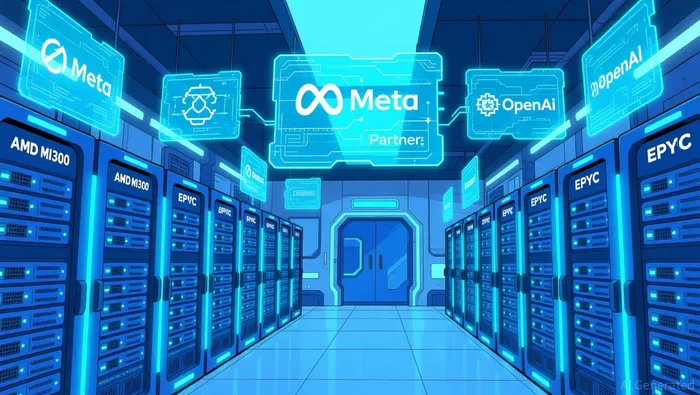
Management has guided for Data Center revenue to grow 68% year-over-year in fiscal 2026, fueled by demand for EPYC server processors and the rapidly scaling Instinct MI300 and MI355X AI accelerators. The MI355X GPU alone delivers a roughly 3x generational jump in performance, offering hyperscale customers a credible, lower-cost alternative for large-scale AI inference clusters. This hardware push is complemented by major partnerships with Meta, OpenAI, and Microsoft, which have validated AMD's role as the primary "second source" for hyperscalers looking to diversify away from single-vendor dependence on Nvidia.
Timeline: Key Events Behind AMD's Record Run
- February 2026 — AMD reports Q4 and full-year 2025 results: record revenue of $34.6B, EPS of $1.53 vs $1.32 expected. Stock initially dips on forward guidance but quickly recovers.
- March 2026 — Meta announces a multi-year agreement with AMD including a performance-based warrant for up to 160 million shares, signaling deep institutional confidence.
- Early April 2026 — AMD stock consolidates in the $250-$270 range as the market digests the AI narrative.
- April 22, 2026 — AMD surges 6% to cross $300 for the first time, driven by broad semiconductor demand and analyst upgrades.
- April 23, 2026 — Stock reaches an all-time intraday high of $304.38.
- April 24, 2026 — AMD shares soar another 12% following Intel's Q1 earnings, which reveal a structural shift in CPU demand for AI workloads that benefits AMD directly.
- April 25, 2026 — DA Davidson upgrades AMD to Buy from Neutral, raising its price target to $375 from $220, citing a "CPU explosion" for AI workloads.
Why AMD Matters Now: Expert Analysis on the AI Opportunity
The analyst community is sharply divided between bullish upgrade cycles and cautious valuation concerns, making this a critical moment for investors to understand the competing narratives.
On the bullish side, DA Davidson analyst Tom White upgraded AMD to Buy with a $375 price target after Intel's Q1 2026 results signaled what he called a "structural increase in CPU demand" driven by agentic AI workloads. "We are upgrading shares of AMD to Buy from Neutral and raising our price target to $375 from $220 based on a structural increase in CPU demand," White wrote. The thesis is that AI inference — the process of running trained AI models — increasingly requires CPU capacity alongside GPUs, creating a massive tailwind for AMD's EPYC processor line.
Stifel set a $320 price target, with analysts noting that every gigawatt of installed AI capacity could generate $15 to $20 billion in net revenue for the company. HSBC analyst Frank Lee raised his target from $185 to $310 with a Buy rating, pointing to the importance of AI infrastructure deals. On Seeking Alpha, analyst JR Research noted that "AMD's share price has broken through major resistance with a powerful bullish engulfing candle within an established uptrend, signaling strong momentum and room for further upside."
However, cautionary voices remain. Goldman Sachs maintains a Neutral rating with a $210 price target, placing it at the lower end of the $210-$380 analyst range. Northland Capital Markets downgraded AMD to Market Perform after 11 years of bullish coverage, citing valuation concerns after the stock's meteoric rise. Morgan Stanley also trimmed its target to $255 post-earnings while keeping an equal-weight rating. The average analyst price target currently sits at approximately $284-$295, suggesting limited upside from current levels near $335 based on the most recent trading data.
Beyond valuation, AMD faces real operational risks. The semi-custom gaming segment — which supplies chips for Sony PlayStation and Microsoft Xbox consoles — is expected to decline by a significant double-digit percentage in 2026 due to a maturing console cycle. The next-generation Xbox is not expected until 2027, creating a revenue gap management has explicitly warned about. Additionally, while AMD's hardware is competitive, Nvidia's CUDA software ecosystem remains a formidable moat that increases switching costs for hyperscale customers.
Where Things Stand Now: Latest on AMD's Rally
As of the latest trading session, AMD shares were trading at $335.45, giving the company a market capitalization of approximately $547 billion — a stunning 248.5% increase over the past year. The stock has outperformed both Nvidia and Broadcom in 2026, cementing its status as the year's top semiconductor performer. Trading volume remains elevated, reflecting sustained institutional interest.
The upcoming earnings report, expected around May 5, 2026, will be the key catalyst for the next leg of the stock's trajectory. The market will be looking for confirmation that AI demand is translating into consistent revenue beats and that management can navigate the cyclical weakness in gaming without derailing the overall growth story. Any sign of margin compression or slowing data center growth could trigger a sharp correction given the stock's premium valuation.
What Happens Next: The Road Ahead for AMD Stock
Looking forward, the AMD investment thesis hinges on several critical factors. First, the company must demonstrate that its AI accelerator roadmap — including the MI355X and future generations — can continue to close the performance gap with Nvidia while maintaining competitive pricing. Second, the CPU capacity arms race driven by agentic AI needs to materialize into sustained revenue growth, with lead times already stretching to months and enabling AMD to implement double-digit price hikes that should lift gross margins.
Hyperscaler capital expenditure is expected to reach $750 billion before year-end and $872 billion in 2027, creating a massive tailwind for chip designers across the board. AMD's full-stack approach — combining high-performance CPUs, custom AI accelerators, and networking solutions via acquisitions like Xilinx and Pensando — positions it to capture more value across the data center stack than pure-play GPU vendors. For investors willing to ride the volatility, the AI infrastructure theme remains one of the most compelling secular growth stories in the market today.
Key Takeaways for Investors
- Record fundamentals: AMD's $34.6B revenue and $4.3B net income in 2025 provide a strong foundation for the bull case
- AI momentum is real: Data center revenue projected to grow 68% in 2026, backed by Meta, OpenAI, and Microsoft partnerships
- Analyst targets vary widely: Price targets range from $210 (Goldman Sachs) to $375 (DA Davidson), reflecting deep uncertainty about valuation
- Watch the May earnings report: The next quarterly results will be the critical test for whether the stock can sustain its momentum
- Risks are real: Gaming segment decline, software ecosystem competition from Nvidia, and premium valuation all pose downside risks