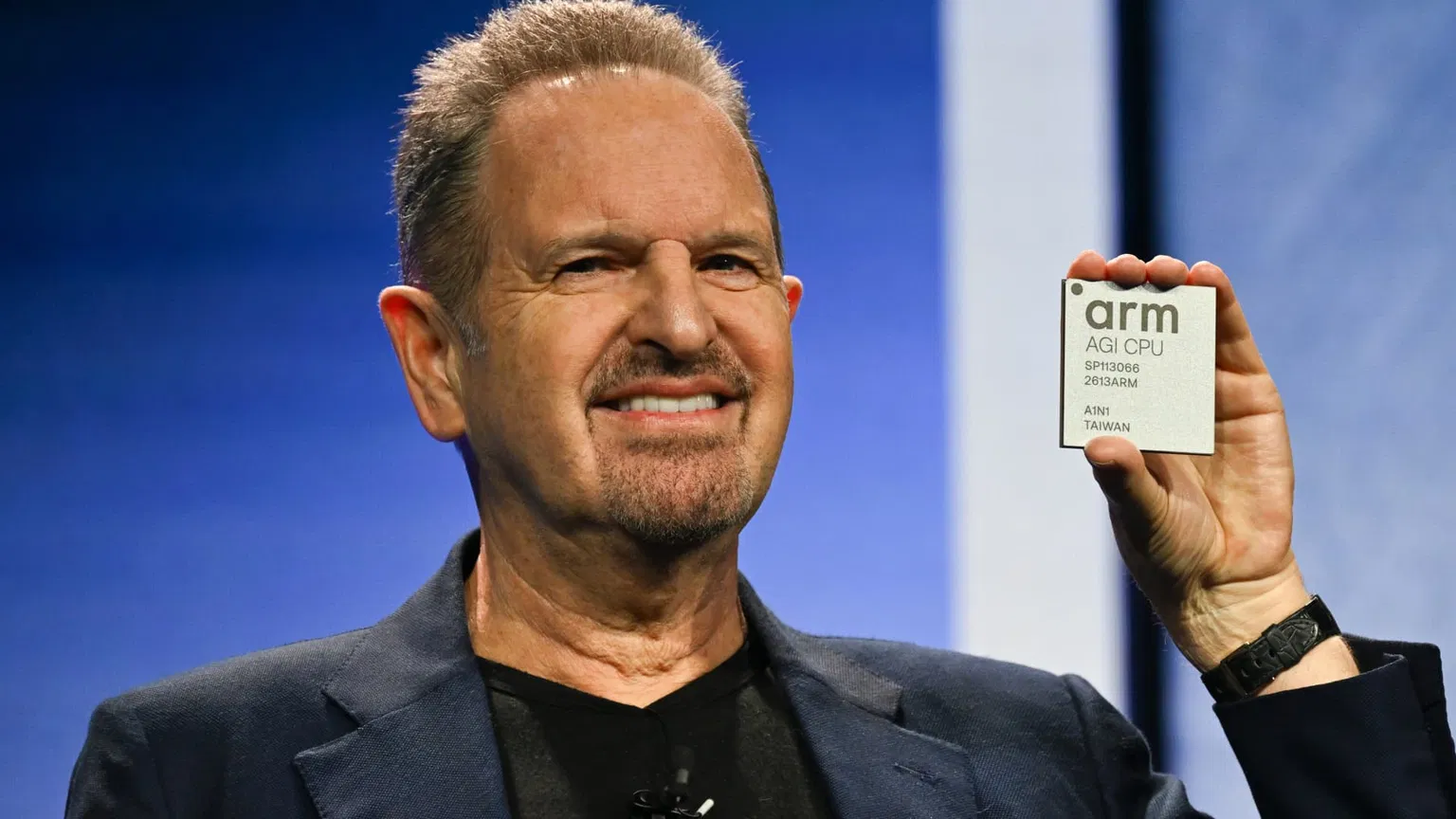
Arm Holdings (NASDAQ: ARM) shares skyrocketed as much as 16% in Wednesday trading after the semiconductor design company unveiled its first-ever in-house processor, the Arm AGI CPU, marking a dramatic pivot from its decades-long IP licensing model. The new artificial general intelligence-focused data center chip, developed in partnership with Meta Platforms, sent shockwaves through the semiconductor sector as analysts projected the move could unlock $15 billion in annual revenue within five years.
The AGI CPU: Arm's Bold Move Into Silicon Manufacturing
The Arm AGI CPU represents a fundamental shift in the company's 35-year business strategy. For the first time, Arm is designing and selling finished silicon rather than just licensing its architecture to partners like Apple, Nvidia, and Amazon. The 136-core processor is specifically optimized for 'agentic AI' workloads—AI systems that can act autonomously on behalf of users—and delivers more than double the performance per rack compared to traditional x86 CPUs, according to company specifications.
Meta is both the lead development partner and first customer, with plans to deploy the chips alongside its custom silicon in gigawatt-scale data centers. This partnership validates Arm's technical approach while providing immediate market entry. CEO Rene Haas told Reuters the AGI CPU targets the "agentic AI" market segment, which represents the next evolution beyond today's large language models toward AI systems that can execute complex tasks independently.
Timeline: How Arm's Silicon Ambition Accelerated
The path to Arm's silicon debut accelerated rapidly over the past year. In early 2025, CEO Rene Haas hinted at 'new business models' during earnings calls as AI infrastructure demand exploded. By Q4 2025, Arm engineers were secretly co-developing the AGI CPU with Meta's infrastructure team. The official unveiling came on March 24, 2026, with Meta announced as the lead customer and deployment partner. Within hours, Barclays analyst Tom O'Malley raised his price target on Arm shares from $165 to $200, citing the 'transformative revenue potential.'
Why This Changes Everything for Arm Investors
Arm's entry into the silicon market positions it directly against established data center CPU players like Intel and AMD, while also challenging Nvidia's dominance in AI accelerators. However, the company's unique approach—focusing on energy-efficient agentic AI workloads—creates a differentiated niche. The AGI CPU's 300-watt power envelope and rack-scale efficiency could translate to $10 billion in capital expenditure savings per gigawatt of AI data center capacity, according to Arm's internal projections.

Financially, the implications are staggering. Arm projects the AGI CPU could generate $15 billion in annual revenue by 2031, with total AI chip revenue potentially reaching $25 billion. For context, the company's entire fiscal 2025 revenue was approximately $4 billion. This represents a 6x revenue expansion opportunity that fundamentally changes Arm's growth trajectory and valuation multiples.
Where Arm Stock Stands Now
As of Thursday morning, Arm shares continued their upward trajectory, trading above $150—a 16% gain from pre-announcement levels. The company maintained its fiscal 2025 revenue guidance of $3.8-$4.1 billion but introduced new long-term projections suggesting total AI chip revenue could reach $25 billion annually by 2031. Multiple analysts have upgraded their ratings and price targets, reflecting growing confidence in Arm's ability to execute this strategic expansion.
The Road Ahead: What Investors Should Watch
The immediate focus will be on ramping production through manufacturing partner TSMC, which will fabricate the chips using its advanced 3-nanometer process. Arm plans to expand its AGI CPU lineup with specialized variants for different AI workloads throughout 2026. Investment analysts are closely watching competitive responses from Intel, AMD, and Nvidia, as well as potential adoption by other hyperscalers like Google Cloud and Microsoft Azure.
For investors, the key risks include execution challenges in high-volume silicon manufacturing, potential competitive price pressure, and the cyclical nature of data center spending. However, the size of the AI infrastructure market—estimated at $1.5 trillion by 2030—provides ample runway for multiple winners.
The Bottom Line: Key Takeaways for Investors
Arm has successfully expanded beyond IP licensing into high-margin silicon sales, the AGI CPU addresses a massive AI infrastructure market with a differentiated approach, and the partnership with Meta provides immediate validation. While execution risks remain, the company's strategic pivot could fundamentally reshape its growth trajectory and valuation in coming years. Investors should monitor production milestones, additional customer announcements, and competitive responses as this story continues to develop.