
AST SpaceMobile shares plummeted more than 14% in premarket trading Monday after Blue Origin's New Glenn rocket failed to place the company's BlueBird 7 satellite into its intended orbit, marking the first major failure of Jeff Bezos' space company's new heavy-launch system. The Texas-based satellite communications company confirmed the $30 million satellite would be deorbited and declared a total loss, though insurance is expected to cover the financial hit. Despite the setback, AST SpaceMobile maintains its ambitious target of placing approximately 45 satellites in orbit by the end of 2026 as it races to build the world's first space-based cellular broadband network.
How the BlueBird 7 Mission Unfolded: Inside the Launch Failure
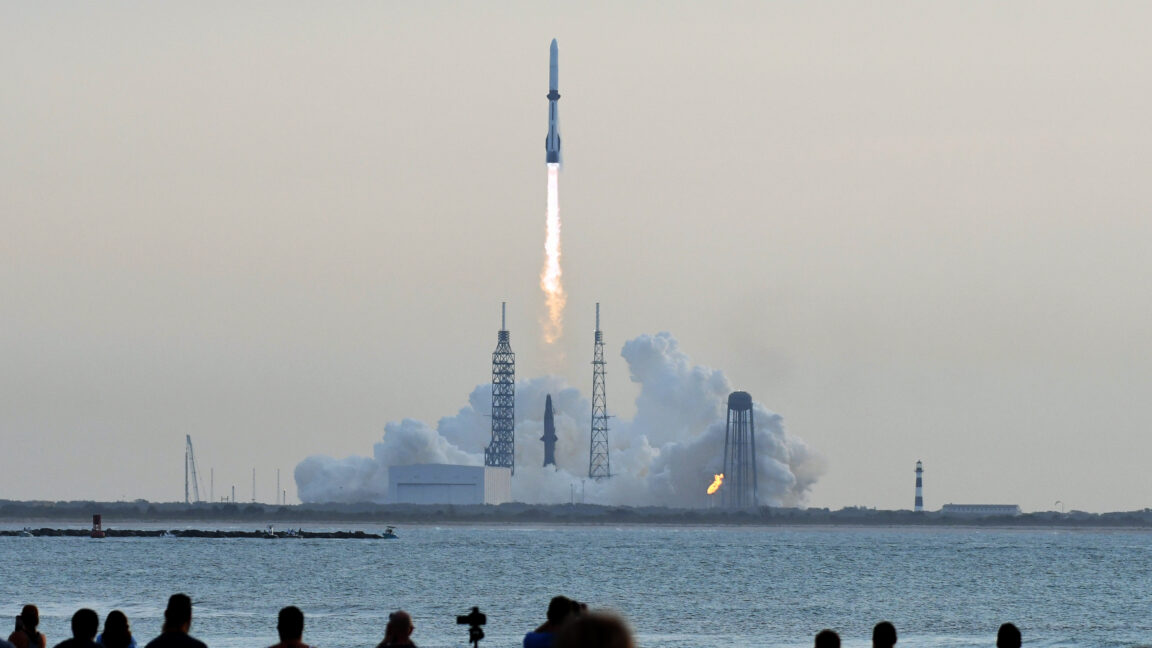
The New Glenn 3 mission lifted off from Cape Canaveral Space Force Station on Sunday with what appeared to be a textbook launch initially. Blue Origin successfully recovered the rocket's first stage booster, marking a significant reuse achievement for the company. However, approximately seven hours after launch, AST SpaceMobile confirmed that BlueBird 7 had been placed into a lower-than-planned orbit by the upper stage of the launch vehicle.
"During the New Glenn 3 mission, BlueBird 7 was placed into a lower than planned orbit by the upper stage of the launch vehicle," the company stated in a press release. "While the satellite separated from the launch vehicle and powered on, the altitude is too low to sustain operations with its on-board thruster technology and will be de-orbited."

BlueBird 7 would have been AST SpaceMobile's eighth satellite deployed into low Earth orbit and represented the company's second full-size Block 2 BlueBird broadband satellite. The spacecraft was designed with advanced solar array technology capable of generating substantial power for direct-to-smartphone connectivity from space. At approximately $30 million per satellite according to industry reports, the loss represents significant hardware value, though the company expects full recovery under its insurance policy.
Timeline: The 24 Hours That Shook AST SpaceMobile Investors
The sequence of events unfolded rapidly over a single day, catching investors off guard. At 6:45 AM EDT Sunday, Blue Origin's New Glenn 3 rocket lifted off from Launch Complex 36 at Cape Canaveral with the BlueBird 7 satellite as its sole payload. Initial telemetry indicated nominal performance through first stage separation and booster recovery.
By 2:00 PM EDT Sunday, approximately seven hours after launch, AST SpaceMobile began receiving data indicating orbital parameters outside expected ranges. At 4:00 PM EDT, the company confirmed the satellite had been placed into an orbit too low for sustained operations. By 6:00 PM EDT, engineering teams determined the satellite's electric propulsion system could not raise the orbit sufficiently, necessitating a deorbit decision.
Pre-market trading Monday morning saw ASTS shares open down 12-14%, with the stock hitting $86.76 in early trading, representing a 5.84% decline from Friday's close. The sharp drop erased gains the stock had made in anticipation of the launch and placed additional pressure on a stock that had already weakened in the days leading up to the mission.
Why This Launch Failure Matters: Expert Analysis and Market Impact
Analysts were quick to dissect the implications of the launch failure for both AST SpaceMobile and the broader commercial space industry. "The malfunction of BlueBird 7 was caused by a failure in the launch rocket and had nothing to do with any deficiencies in the technological design of the satellite itself," noted a Seeking Alpha analyst in a report titled "AST SpaceMobile: The Pullback I Was Waiting For."
This distinction is crucial for investors evaluating the long-term prospects of AST SpaceMobile. The company's technology—which aims to provide direct satellite-to-smartphone connectivity without requiring specialized hardware—remains untested by this failure. What has been tested is the reliability of Blue Origin's New Glenn rocket, which now faces scrutiny after its first major payload delivery failure.
Financial analysts point to the insurance coverage as a critical mitigating factor. "The cost of the satellite is expected to be recovered under the company's insurance policy," AST SpaceMobile confirmed in its statement. With the satellite reportedly insured for $30 million, the direct financial impact on AST SpaceMobile's balance sheet should be minimal. However, the operational setback removes a high-capacity Block 2 unit from the company's 2026 deployment timeline, potentially delaying revenue generation from that specific asset.
Market reaction extended beyond AST SpaceMobile, with Blue Origin's reputation taking a hit in the competitive launch services market. The failure comes at a time when Blue Origin is attempting to establish New Glenn as a reliable competitor to SpaceX's Falcon rockets in the heavy-lift category. While the successful booster recovery demonstrates progress in reuse technology, the upper stage failure raises questions about overall system reliability.
Where Things Stand Now: AST SpaceMobile's Current Position
Despite the BlueBird 7 loss, AST SpaceMobile maintains an aggressive production and launch schedule. The company is currently manufacturing satellites through BlueBird 32, with BlueBird 8 through 10 expected to be ready for shipment in approximately 30 days. This pipeline suggests the company has sufficient hardware in production to maintain its deployment cadence, assuming launch providers can deliver reliable access to space.
"The company continues to expect an orbital launch every one to two months on average during 2026, supported by agreements with multiple launch providers," AST SpaceMobile stated, reaffirming its commitment to the timeline that investors have been monitoring closely. This multi-provider strategy—which includes partnerships with SpaceX in addition to Blue Origin—provides some redundancy should one provider experience extended reliability issues.
Financially, AST SpaceMobile reported having $3.9 billion in liquidity and $1.075 billion in new convertible notes as of its most recent quarterly report, providing substantial runway for continued operations. The company's revenue projections remain ambitious, with analysts expecting approximately $180 million in 2026 revenue scaling to $1.8 billion by 2028 as the constellation becomes operational.
What Happens Next: The Road Ahead for AST SpaceMobile
The immediate focus for AST SpaceMobile will be determining the root cause of the launch failure in coordination with Blue Origin and proceeding with upcoming launches as scheduled. The company's next satellite, BlueBird 8, is slated for launch in the coming weeks, though the specific launch provider and timeline may see adjustments following the New Glenn 3 investigation.
Longer term, the incident highlights the inherent risks in the space launch business and may prompt AST SpaceMobile to further diversify its launch provider portfolio. The company's ability to execute on its promised launch cadence of every 1-2 months now faces increased scrutiny from investors who had already priced in significant execution risk.
From an investment perspective, the stock's sharp decline presents a classic "bad news is already priced in" scenario for some analysts. "AST SpaceMobile: The Pullback I Was Waiting For" suggests that for investors with a long-term horizon and tolerance for space industry volatility, the current price may represent an attractive entry point. However, the company now faces increased pressure to demonstrate flawless execution through the remainder of 2026 to rebuild investor confidence.
The Bottom Line: Key Takeaways for Investors
AST SpaceMobile's BlueBird 7 launch failure represents a significant operational setback but not necessarily a fundamental threat to the company's long-term strategy. The $30 million satellite loss is covered by insurance, minimizing financial impact. The failure originated with Blue Origin's launch vehicle, not AST SpaceMobile's satellite technology. The company maintains its aggressive deployment schedule targeting 45 satellites in orbit by year-end 2026. Stock reaction has been severe but may present opportunity for risk-tolerant investors believing in the space-based cellular broadband thesis.
As the commercial space industry continues to mature, such setbacks remind investors of the substantial technical challenges involved in building infrastructure beyond Earth's atmosphere. For AST SpaceMobile specifically, the coming months will be critical in demonstrating whether the company can maintain its promised launch cadence and move past this week's disappointing mission.