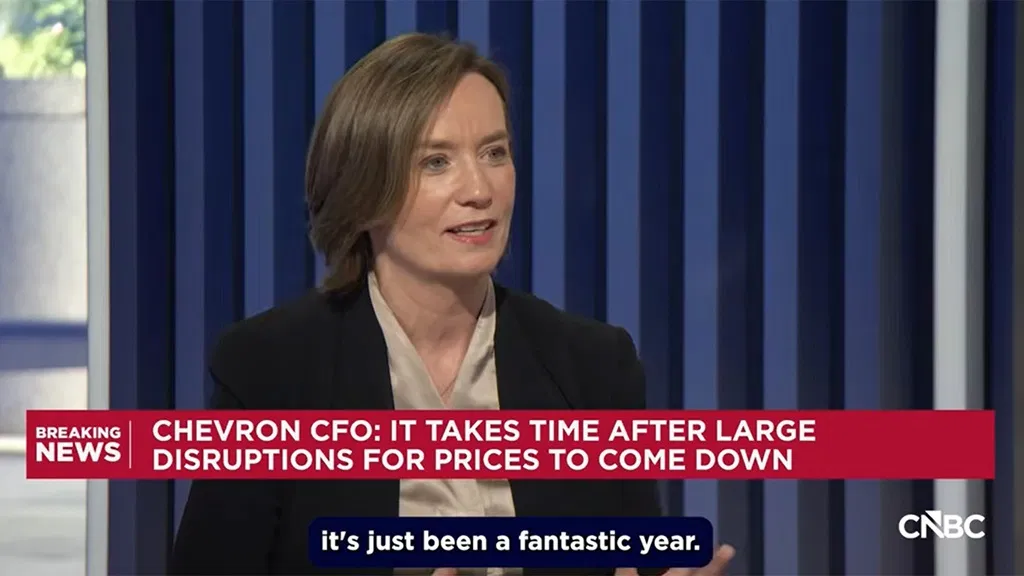
Chevron (NYSE: CVX) is in the middle of its best year in decades. The energy giant's stock touched an all-time closing high of $226.78 on October 21, 2026, capping a rally that has lifted shares roughly 45% since January — and more than 52% on a total-return basis once dividends are counted. For investors, the surge is more than a short-term trade: it is the payoff from a $55 billion acquisition, surging crude prices, and a production engine firing on all cylinders from Guyana to the Permian Basin.
The momentum has made Chevron one of the strongest-performing large-cap energy stocks of 2026, outpacing both the broader energy sector and rival ExxonMobil over the past six months. Here is what is driving the rally, where the stock stands now, and what investors should watch next.
Inside the $55 Billion Hess Bet That Is Paying Off
Much of Chevron's current strength traces back to a single decision: its $55 billion acquisition of Hess Corporation. The deal, first announced in October 2023, was held up for nearly two years by a legal fight with ExxonMobil over the transaction's crown jewel — Hess's 30% stake in the Stabroek block offshore Guyana, one of the most prolific oil discoveries of the century.
Chevron ultimately prevailed in a landmark arbitration ruling and closed the acquisition on July 18, 2025. The prize was enormous: a deepwater basin where more than 11 billion barrels of recoverable oil equivalent had already been discovered. One year later, Chevron reported the merger was delivering $1.5 billion in synergies, strong free cash flow, and major producing assets in both Guyana and North Dakota's Bakken shale.
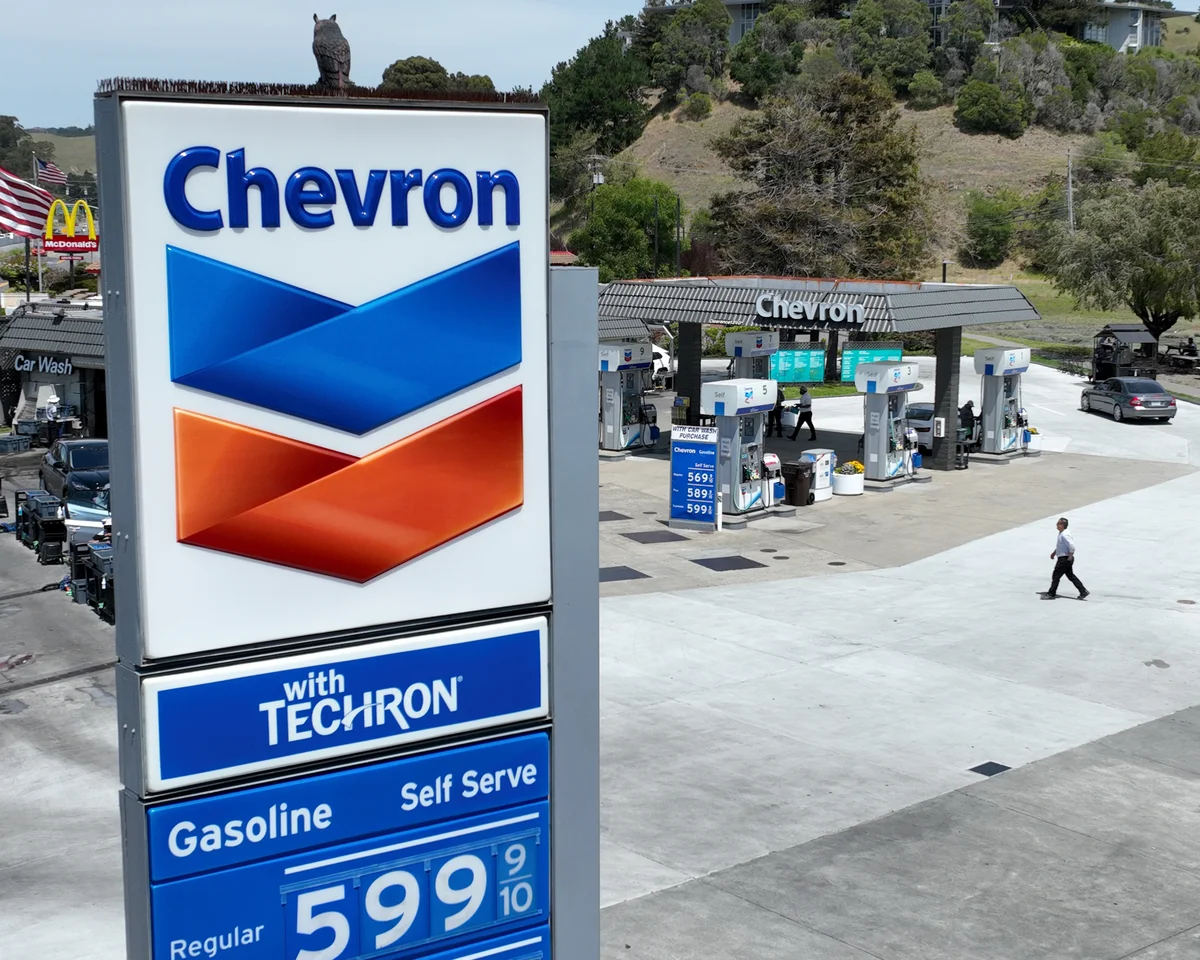
Those Guyana barrels matter. Unlike shale, which requires constant drilling to hold output flat, Guyana's offshore wells produce at low cost and high margin, giving Chevron a growing stream of cash flow that analysts view as increasingly resilient even if oil prices cool.
From Exxon's Challenge to Record Highs: Chevron's 2026 Timeline
The road to Chevron's all-time high was not a straight line. Here is how the key moments unfolded:
July 18, 2025 — Chevron completes its $55 billion acquisition of Hess after winning arbitration against ExxonMobil.
January 3, 2026 — The United States captures Nicolás Maduro, a geopolitical shock that reshapes Venezuela's oil outlook and lifts energy stocks broadly.
May 1, 2026 — Chevron beats earnings expectations and reports returning $6 billion to shareholders — $3.5 billion in dividends and $2.5 billion in buybacks.
July 31, 2026 — One year after the Hess close, Chevron reports $1.5 billion in merger synergies and strong free cash flow.
September 2, 2026 — Chevron announces a $7 billion plan to expand in Venezuela, targeting a doubling of production to 600,000 barrels per day. Crude tops $90 a barrel.
September 23, 2026 — Chevron reveals a more than 50% increase in exploration spending for next year.
October 21, 2026 — The stock closes at a record $226.78, with a 52-week high of $229.04.
Why the Rally Keeps Going: Oil, Guyana, and Venezuela
Three forces are combining to keep Chevron's stock near record territory. The first is crude oil itself. Benchmark prices surged in 2026, with oil up about 58% on the year and topping $90 per barrel by early September. Because Chevron carries more direct oil-price leverage than many of its diversified peers, it benefits disproportionately when crude climbs.
The second is production growth. Beyond Guyana, Chevron has been expanding output in the Permian Basin and Kazakhstan, while its existing Venezuelan ventures grew production 15% this year. The newly announced Venezuela plan — backed by additional acreage in the Orinoco Belt — would more than double the company's output there over five years, from roughly 280,000 to 600,000 barrels per day.
The third is a disciplined balance sheet and steady shareholder returns. Chevron has reduced debt since closing the Hess deal and continues to pay a $1.78 quarterly dividend, which works out to a yield in the 3% to 4% range even after the stock's run. That combination of growth, income, and a cleaner balance sheet has made Chevron a favorite of both income investors and momentum buyers.
Where Chevron Stands Now: Price, Dividend, and Valuation
As of late October 2026, Chevron shares traded around $226, just below their record. The run-up has pushed the stock to roughly 21 times normalized earnings, above its historical average and above many analysts' earlier price targets — some of which sat near $205 before the latest leg higher.
That does not mean the rally is over, but it does raise the bar for future returns. Chevron's forward dividend yield of around 3% remains attractive, though less generous than the roughly 4% it offered earlier in the year. Buybacks remain active, and management has signaled it will keep returning excess cash to shareholders.
The central caveat is leverage to oil prices. Because Chevron's earnings move more directly with crude than more diversified majors, a sharp pullback in oil would hit the stock harder. Analysts consistently flag that sensitivity as the key risk with shares at record highs.
What's Next: Exploration, Production, and the Risks Ahead
Chevron is not standing still. The company plans to lift exploration spending by more than 50% next year, betting it can extend its Guyana-style success to new basins. Management also expects the Hess integration to keep outperforming its original synergy targets, and the Venezuela expansion offers a long-dated growth option if the country's political stabilization holds.
Still, investors should weigh the risks. Oil prices are volatile and policy-sensitive, and the same geopolitical forces that lifted crude in 2026 could reverse. With Chevron trading at a premium to its own history, future returns depend more on execution and commodity prices than on a cheap starting valuation. Analysts broadly rate the stock a hold to moderate buy, with average price targets clustering in the low-to-mid $230s.
The Bottom Line for Investors
Chevron's record-setting 2026 is a case study in how a well-timed acquisition, rising oil prices, and disciplined capital returns can transform a stock. The key takeaways:
- Chevron hit an all-time closing high of $226.78 on October 21, 2026, up roughly 45% for the year.
- The $55 billion Hess acquisition added Guyana's Stabroek block and delivered $1.5 billion in synergies.
- Surging oil (above $90 a barrel) and production growth in Guyana, the Permian, and Venezuela are fueling earnings.
- The $1.78 quarterly dividend and buybacks continue, though the yield has narrowed as the stock rose.
- The biggest risk is Chevron's outsized sensitivity to a potential decline in oil prices.