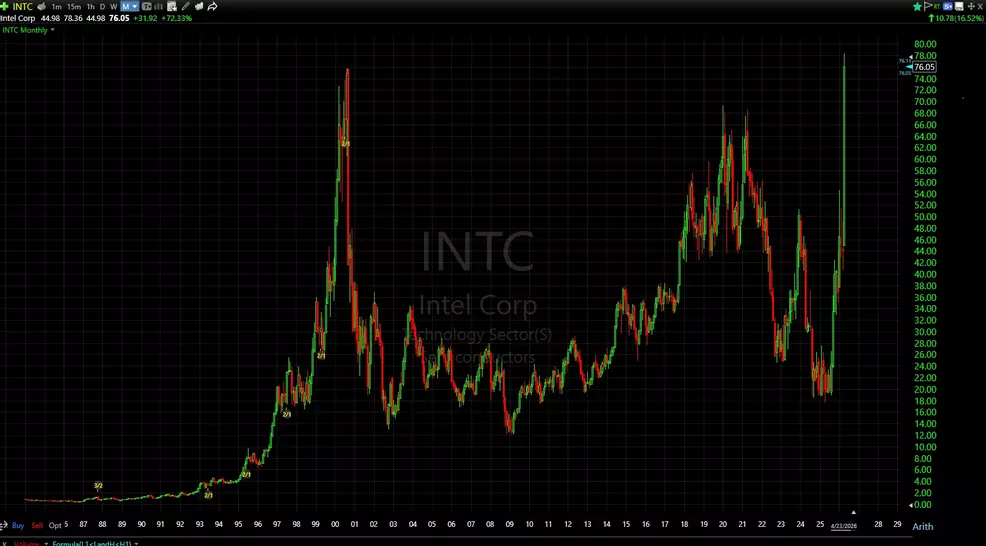
Intel stock exploded more than 25% higher on Friday, April 24, smashing through its dot-com era all-time high after the chipmaker delivered a stunning Q1 2026 earnings report that blew past Wall Street expectations. Shares surged to over $83 in early trading, eclipsing the previous intraday record of $75.81 set on August 28, 2000, and extending a remarkable turnaround that has seen the stock more than double over the past year.
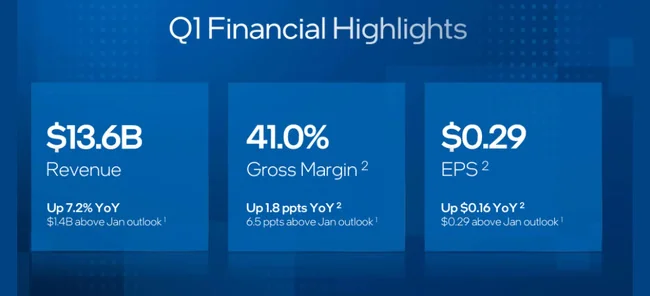
The catalyst was Intel's Q1 earnings release after Thursday's close, which showed adjusted earnings per share of $0.29 on revenue of $13.6 billion — crushing analyst estimates that called for just $0.02 EPS on $12.36 billion in revenue. It marked the company's sixth consecutive quarter of exceeding its own financial expectations, validating the turnaround strategy under new CEO Lip-Bu Tan.
How the Earnings Blowout Unfolded: Inside Intel's Historic Quarter
Intel reported first-quarter revenue that rose approximately 7% year-over-year from $12.7 billion, coming in roughly $1.4 billion above the midpoint of the company's own conservative January outlook of $11.7 billion to $12.7 billion. Non-GAAP gross margin improved to 41% from 39.2% a year ago, signaling that Intel is not just growing revenue but also recovering profitability that had eroded over the past two years.
The standout performer was Intel's Data Center and AI (DCAI) segment, which posted revenue of $5.1 billion — a 22% year-over-year surge. This marks a critical validation of Intel's AI strategy, showing that the company can benefit from the AI boom through its CPU's role as a "host" processor in AI clusters. "The next wave of AI will bring intelligence closer to the end user, moving from foundational models to inference to agentic," said CEO Lip-Bu Tan. "This shift is significantly increasing the need for Intel's CPUs and wafer and advanced packaging offerings."
The Client Computing Group (CCG) delivered $7.7 billion in revenue, up 1% year-over-year, while Intel Foundry grew 16% to $5.4 billion. On an adjusted non-GAAP basis, operating margin more than doubled to 12.3% from 5.4% a year ago.
Timeline: How Intel's Comeback Unfolded Over 12 Months
Intel's path back to record highs has been nothing short of remarkable. Less than a year ago, the stock was trading below $18 — a shadow of its former self after years of market share losses, manufacturing delays, and missed AI opportunities. Here are the key milestones that led to this week's historic breakout:
- 2024: Intel struggles through a prolonged downturn, posting GAAP net losses and negative cash flow from operations for most of the year. The stock languishes near multi-decade lows.
- Early 2025: The U.S. government takes a roughly 10% stake in Intel as part of the CHIPS Act push to revitalize domestic semiconductor manufacturing. The stock begins to stabilize.
- Mid-2025: Intel starts delivering consistent quarterly beats, each one building investor confidence. The stock climbs steadily through the year, rising about 84% in 2025 alone.
- Early 2026: New CEO Lip-Bu Tan takes the helm and accelerates the "reset" strategy. Tesla announces plans to use Intel's chip fabs. The stock continues its upward trajectory.
- April 23, 2026: Intel reports Q1 earnings with a $1.4B revenue beat and $0.29 EPS — nearly 15x expectations. The stock surges past $83 in after-hours and pre-market trading, breaking the dot-com record.
- April 24, 2026: Shares open at over $83, surpassing the previous all-time high of $75.81 set more than 25 years earlier during the tech bubble.
Why This Matters: What Intel's Record-Breaking Rally Means for Investors
The magnitude of Intel's breakout cannot be overstated. The stock has now more than doubled year-to-date and has quadrupled from its 52-week lows — making it one of the best-performing large-cap stocks in the market. But beneath the headline numbers lie important dynamics that investors need to understand.
Wall Street remains divided on the stock despite the historic rally. While some analysts have rushed to raise price targets — TD Cowen bumped its target to $75 from $60 — others maintain a cautious stance. The TradingView analysis noted that even with a 28% surge, several analysts still rate Intel a "Sell," citing execution risks and the enormous capital expenditure required for Intel's foundry ambitions.
The numbers, however, tell a compelling story. Intel generated roughly $1.1 billion in cash from operations in Q1, and guided Q2 2026 revenue of $13.8 billion to $14.8 billion with non-GAAP EPS around $0.20. That guidance alone was well above Street expectations, suggesting momentum is building. Non-GAAP net income for Q1 hit $1.5 billion — more than double the $0.6 billion reported a year ago.
The AI angle is particularly significant. Intel's DCAI segment grew 22% as hyperscale cloud providers increasingly deploy Intel CPUs alongside GPUs for AI inference workloads. Management emphasized that the next wave of AI — agentic models running closer to the user — plays directly to Intel's strengths in power-efficient computing and advanced packaging.
Where Things Stand Now: Latest on Intel's Historic Rally
As of Friday morning trading, Intel shares were changing hands above $83, representing a gain of more than 25% from Thursday's close of approximately $66. The move has pushed Intel's market capitalization well past $300 billion for the first time in years. Trading volume has exploded, with more than 100 million shares changing hands in the first few hours alone — several times the average daily volume. CNBC reported that two Wall Street firms upgraded Intel to a "Buy" following the earnings release, adding to the buying pressure. The rally has also lifted the broader semiconductor sector, with the Philadelphia Semiconductor Index posting gains as investors reassess Intel's competitive position against rivals like Nvidia and AMD.
What Happens Next: The Road Ahead for Intel Stock
With the stock now trading at levels that already price in significant success, the question on every investor's mind is whether Intel can sustain its momentum. The Q2 guidance of $13.8-$14.8 billion in revenue implies continued growth, and management's commentary about AI-driven demand suggests tailwinds could persist. Key catalysts to watch include the ongoing ramp of Intel's foundry business, new customer wins beyond Tesla, and the company's ability to continue improving gross margins toward the 50%+ levels that would justify its current valuation. CEO Lip-Bu Tan summed it up succinctly: "With a solid foundation in place, we are addressing this opportunity by listening to our customers and driving their success with our technical expertise and differentiated IP." For long-suffering Intel investors, those words carry more weight than they have in years.
Key Takeaways from Intel's Record-Breaking Week
- Intel stock surged over 25% to break its dot-com all-time high of $75.81, reaching above $83 per share
- Q1 2026 revenue of $13.6B beat expectations by $1.4B; non-GAAP EPS of $0.29 crushed the $0.02 estimate
- Data Center and AI revenue jumped 22% YoY, validating Intel's AI turnaround strategy
- The stock is up over 100% year-to-date and has quadrupled from 52-week lows below $19
- Intel guided Q2 2026 revenue of $13.8-$14.8B, above analyst expectations, signaling continued momentum
- New CEO Lip-Bu Tan has delivered a sixth consecutive quarter of results above Intel's own forecasts