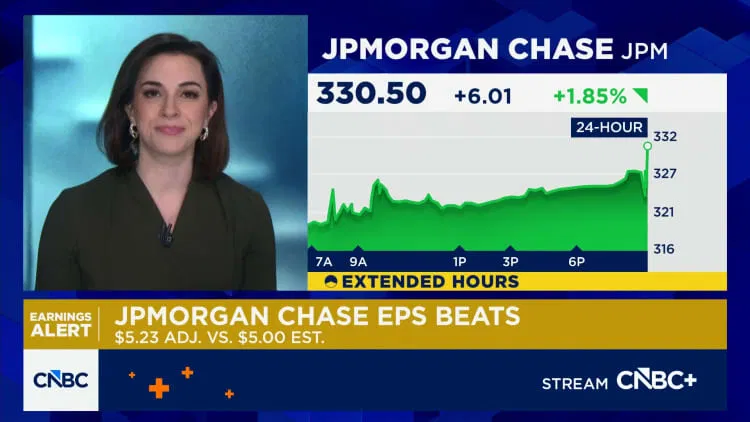
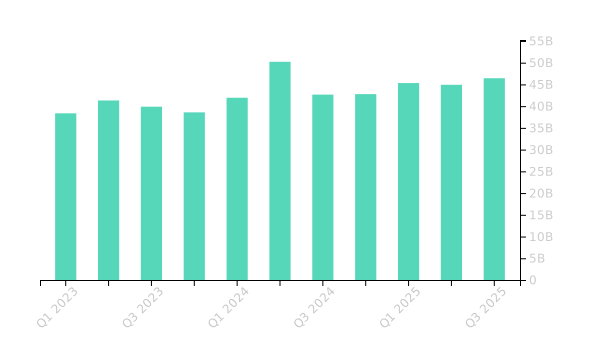
JPMorgan Chase kicked off bank earnings season with a mixed fourth-quarter report that beat Wall Street expectations on strong trading revenue but disappointed investors with weaker investment banking results. The largest U.S. bank reported adjusted earnings of $5.23 per share for Q4 2025, topping the $5.00 consensus estimate, while revenue reached $46.77 billion against expectations of $46.20 billion. However, shares fell nearly 3% in Tuesday trading as investment banking fees missed forecasts and concerns mounted over proposed credit card rate caps from the Trump administration.
How JPMorgan's Trading Desk Saved the Quarter
While overall profit fell 7% to $13.03 billion due to a $2.2 billion provision tied to the bank's takeover of the Apple Card portfolio from Goldman Sachs, JPMorgan's trading operations delivered spectacular results. Equity trading revenue surged 40% to $2.9 billion, approximately $350 million above analyst expectations, while fixed income trading rose 7% to $5.4 billion, beating estimates by $110 million.
"The U.S. economy has remained resilient," CEO Jamie Dimon said in the earnings release. "These conditions could persist for some time, particularly with ongoing fiscal stimulus, the benefits of deregulation and the Fed's recent monetary policy." Dimon added that markets seem to underappreciate potential hazards including complex geopolitical conditions, sticky inflation, and elevated asset prices.
Net interest income, the difference between what banks earn on loans and pay on deposits, increased 7% to $25.1 billion, roughly matching analyst expectations. The bank's consumer division showed stability despite softer labor markets, with Chief Financial Officer Jeremy Barnum noting, "Consumers and small businesses remain resilient" and that the bank wasn't seeing deterioration across income groups.
Timeline: The Road to JPMorgan's Q4 Earnings Release
The path to Tuesday's earnings release was marked by several key developments that shaped the quarter's results:
- October 2025: JPMorgan raises its full-year net interest income forecast after strong Q3 trading performance, setting expectations high for the final quarter.
- December 9, 2025: The bank warns that 2026 expenses could reach approximately $105 billion, driven by growth and volume-related costs.
- January 7, 2026: JPMorgan announces its takeover of the Apple Card portfolio from Goldman Sachs, triggering a $2.2 billion provision that would impact Q4 results.
- January 12, 2026: The Trump administration proposes capping credit card interest rates at 10%, sending financial stocks lower ahead of earnings.
- January 13, 2026: JPMorgan releases Q4 results before market open, beating earnings estimates but missing on investment banking revenue.
Why Investment Banking Disappointed and What It Means
The quarter's most notable weakness came from JPMorgan's investment banking division, where fees fell 5% to $2.3 billion, approximately $210 million below Wall Street expectations. This disappointed analysts who had anticipated stronger dealmaking activity given the record-high equity markets and expectations of interest rate cuts.
"Investment banking was a bit disappointing but expect forward commentary to be more constructive, while average loan growth accelerating bodes well for the lending side," said Stephen Biggar, an analyst at Argus Research. Despite the quarterly miss, JPMorgan extended its run as the world's top investment bank, earning the highest fees for the year according to Dealogic data.
The bank worked on several high-profile transactions during the quarter, including advising Warner Bros Discovery on its $82.7 billion deal with Netflix and Kimberly-Clark on its $48.7 billion acquisition of Kenvue. It also served as lead underwriter on medical supplies giant Medline's IPO, the largest listing globally in 2025.
Where JPMorgan Stands Now: The 2026 Outlook
Looking ahead to 2026, JPMorgan provided guidance that generally exceeded analyst expectations. The bank expects full-year net interest income of approximately $103 billion, above the $100 billion consensus estimate, though both NII and expense projections are "market dependent." Adjusted expenses are projected at roughly $105 billion.
Key business segments showed divergent trends heading into the new year. Asset & Wealth Management saw assets under management grow 18% year-over-year, while Commercial & Investment Banking revenue increased 10%. However, Consumer Banking net income fell 19%, reflecting the impact of the Apple Card provision and softer consumer sentiment.
Analysts will be watching several key metrics in coming quarters, including whether the trading momentum can continue, if investment banking rebounds as expected, and how the bank navigates potential regulatory changes. "I wouldn't expect a whole lot out of JPM stock today, as the stock is coming off a great year where the bar for perfection is set pretty high," said David Wagner, head of equities at Aptus Capital Advisors, which holds shares of the bank.
What Happens Next: Key Catalysts for JPM Stock
Several upcoming developments could significantly impact JPMorgan's stock performance in 2026:
- Credit Card Regulation: The Trump administration's proposed 10% cap on credit card interest rates could dramatically affect JPMorgan's profitable card business if implemented. CFO Jeremy Barnum warned that such a move would be "very bad for consumers, very bad for the economy" and force significant business model changes.
- Federal Reserve Policy: The timing and magnitude of interest rate cuts will directly impact net interest income, with lower rates potentially pressuring margins but stimulating borrowing activity.
- Investment Banking Recovery: Bankers remain optimistic that dealmaking will accelerate through 2026, driven by record equity markets and anticipated rate cuts. A rebound here could significantly boost earnings.
- Consumer Health: With labor markets showing some softening, any deterioration in consumer credit quality could trigger higher loan loss provisions.
- Political Developments: The 2026 midterm elections and ongoing geopolitical tensions could create both risks and opportunities for the banking sector.
The Bottom Line: Key Takeaways for Investors
JPMorgan Chase's Q4 results present a classic "good news, bad news" scenario for investors. The bank demonstrated exceptional strength in trading operations but revealed vulnerabilities in investment banking. For investors considering JPM stock, several key points emerge:
- Strength in Volatility: JPMorgan's trading desks proved they can capitalize on market volatility, a valuable capability in uncertain times.
- Leadership Position: Despite the investment banking miss, JPMorgan remains the world's top investment bank with dominant market positions across multiple businesses.
- Regulatory Risk: Proposed credit card rate caps represent a significant potential headwind that investors must monitor closely.
- Valuation Considerations: With shares down from recent highs but still up 34% in 2025, valuation remains rich at current levels, requiring strong execution to justify.
- Dividend Stability: As a historically strong dividend payer with consistent buybacks, JPMorgan offers income appeal for long-term investors.
As the banking sector's earnings season continues with results from Bank of America, Citigroup, Wells Fargo, Goldman Sachs, and Morgan Stanley, JPMorgan's mixed results set a tone of cautious optimism. The bank's ability to navigate economic crosscurrents while maintaining profitability will be tested throughout 2026, making it a bellwether worth watching for both banking sector investors and those monitoring the broader economy.