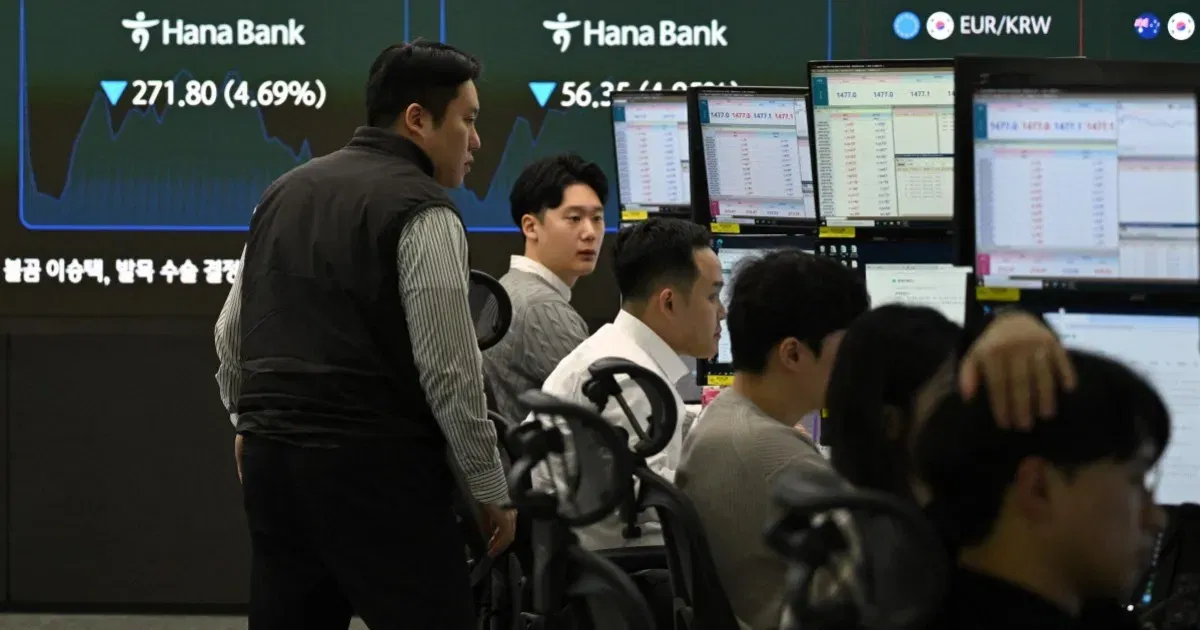
South Korea's stock market just experienced one of the most dramatic rollercoaster rides in financial history, with the benchmark KOSPI index plunging 12.06% on Wednesday, March 4, 2026—the worst single-day drop since the September 11 attacks—only to stage an equally spectacular 12% rebound the very next day. This unprecedented volatility, which wiped out nearly $554 billion in market value before recovering most losses within 24 hours, has sent shockwaves through global markets and left retail investors reeling from margin calls and panic selling. The extreme movements underscore both the fragility of South Korea's leveraged retail investor ecosystem and the market's acute sensitivity to geopolitical tensions, particularly the escalating Iran conflict that triggered the initial selloff.
How the KOSPI Meltdown Unfolded: Inside Asia's Wildest Trading Week
The crisis began on Tuesday, March 3, 2026, when the KOSPI fell 7.2% amid growing concerns about the economic impact of the expanding Iran war. This already significant decline set the stage for Wednesday's historic collapse. As Asian markets opened on March 4, the KOSPI plunged immediately, dropping 8% within the first hour of trading and triggering circuit breakers that temporarily halted trading. By the close, the index had fallen 12.06% to 5,093.54 points—a staggering 698.37-point decline that eclipsed any previous single-day drop, including the 12.02% crash following the 9/11 attacks.
The selling was concentrated in South Korea's largest companies, with Samsung Electronics plummeting 11.7%, SK Hynix falling 9.6%, and Hyundai Motor dropping 8.4%. According to Bloomberg data, the two-day plunge of approximately 20% represented the worst performance since the 2008 global financial crisis, wiping out 817.6 trillion won ($553.82 billion) in market capitalization. Retail investors, who had borrowed heavily to invest during the market's spectacular run-up, faced cascading margin calls that accelerated the downward spiral. "The scale of the decline reflected both geopolitical shock and positioning," analysts at Nikkei Asia noted, pointing out that South Korean equities had rallied strongly in recent years, more than doubling to over 6,000 points before the crash.
Timeline: From Record Crash to Historic Rebound in 48 Hours
The sequence of events that transformed South Korea's stock market from bull market darling to crisis zone and back again unfolded with breathtaking speed. On Tuesday, March 3, the KOSPI fell 7.2% as oil prices surged above $120 per barrel following the escalation of the Iran conflict. Wednesday morning saw panic set in, with the index dropping 8% by 11:19 a.m. local time, triggering a market-wide circuit breaker that halted trading for 20 minutes. When trading resumed, the selling intensified, pushing the decline to 10% by noon and ultimately reaching 12.06% at the close—the worst single session in the exchange's history.
Thursday, March 5, brought one of the most dramatic reversals in financial market history. The KOSPI opened at 5,685.47, immediately regaining most of Wednesday's losses, and surged as much as 12% during the session before closing with a 9.6% gain—the largest single-day advance since October 2008. According to Trading Economics data, the index then stabilized at around 5,585 points on March 6, representing a 0.02% gain from the previous session and leaving it up 5.41% over the past month and an astonishing 117.86% higher than the same time last year.
Why the KOSPI Crash Matters: Expert Analysis and Global Impact
Financial analysts point to three interconnected factors that created the perfect storm for South Korea's markets: extreme energy dependency, foreign exchange weakness, and unprecedented retail leverage. As Seeking Alpha's analysis notes, "South Korea's KOSPI index crashed nearly 20% in two days, driven by energy dependency, FX weakness, and leveraged margin calls." The country imports nearly all its oil, making it exceptionally vulnerable to energy price shocks. When the Iran conflict pushed crude prices above $120, concerns about inflation and corporate profitability triggered the initial selloff.
The situation was exacerbated by the Korean won's weakness against the dollar, which increased the cost of servicing foreign-denominated debt and prompted foreign investors to exit Korean assets. But the most distinctive factor was the massive leverage employed by retail investors. According to Reuters, "South Korean retail investors panic as world-beating stock gains vanish" as margin calls forced them to sell into a declining market, creating a vicious cycle. Data from the Korea Financial Investment Association shows margin debt had reached record levels before the crash, with retail investors accounting for approximately 80% of daily trading volume.
Where Things Stand Now: Latest on KOSPI Recovery and Market Sentiment
As of March 6, 2026, the KOSPI has stabilized around 5,585 points, but the psychological damage to investor confidence may take longer to repair. Trading Economics reports that while the index has climbed 5.41% over the past month and remains up 117.86% year-over-year, the extreme volatility has prompted regulatory scrutiny. Financial authorities are examining potential adjustments to margin requirements and circuit breaker mechanisms to prevent similar episodes. Meanwhile, the Bank of Korea has indicated it stands ready to provide liquidity if needed, though it has not yet intervened directly in equity markets.
Market participants report continued nervousness among retail investors, many of whom suffered significant losses during the crash despite the subsequent rebound. "The strength followed a scary start to Wednesday when South Korea's Kospi stock index plunged 12.1% for its worst loss in history," noted one market observer. Foreign institutional investors have been net buyers during the recovery phase, suggesting they view the selloff as a buying opportunity rather than a fundamental deterioration in South Korea's economic prospects.
What Happens Next: The Road Ahead for South Korean Markets
Looking forward, analysts expect continued volatility but believe the worst of the selling pressure has passed. The key variables to watch are oil prices, geopolitical developments in the Middle East, and domestic regulatory responses. If oil stabilizes below $100 per barrel and diplomatic efforts show progress in the Iran conflict, South Korean markets could resume their upward trajectory, albeit with heightened awareness of risk. However, further escalation in the region could trigger another round of selling, particularly if it coincides with additional margin call pressures.
Longer term, the episode serves as a cautionary tale about the dangers of excessive leverage in retail investing and the vulnerability of export-dependent economies to geopolitical shocks. As one analyst summarized, "This crash signals systemic risk for global markets, especially in interconnected IT/AI sectors reliant on South Korean supply chains." Investors with exposure to Korean assets should consider reducing leverage, diversifying across sectors less sensitive to energy prices, and maintaining sufficient liquidity to weather potential future volatility.
The Bottom Line: Key Points for Investors to Remember
First, the KOSPI's 12% crash and subsequent 12% rebound represent unprecedented volatility driven by geopolitical tensions and leveraged retail investing. Second, South Korea's extreme energy dependency makes its markets particularly sensitive to oil price shocks from conflicts like the Iran war. Third, record levels of margin debt among retail investors amplified the downward move through forced selling. Fourth, despite the recovery, regulatory changes are likely that could affect trading conditions and leverage limits. Finally, while the long-term growth story for South Korea's technology-driven economy remains intact, investors should prepare for continued volatility and ensure their portfolios can withstand similar shocks in the future.