Yahoo Finance, the world's #1 financial news and data destination with over 150 million monthly active users, is undergoing its most significant transformation in decades. What began as a simple stock quote service in 1997 has evolved into a comprehensive financial ecosystem that now charges up to $500 annually for premium data access while hosting conferences that attract Wall Street's most influential voices. For investors navigating today's complex markets, understanding Yahoo Finance's evolution provides critical insights into the changing landscape of financial information and what it means for investment decisions.
How Yahoo Finance is Redefining Financial Data Access
In April 2024, Yahoo Finance unveiled a complete overhaul of its platform with the launch of three premium subscription tiers that mark a fundamental shift in how investors access financial data. The Bronze Plan, designed for everyday investors, offers enhanced portfolio tracking, diversification analysis, and risk exposure tools. The Silver Plan targets experienced investors with professional analyst ratings, premium news feeds from sources like the Financial Times and The Information, and independent research reports. Most significantly, the Gold Plan—priced at approximately $500 annually—caters to active traders with premium charts, advanced screener tools, and access to over 40 years of historical downloadable data for building custom trading models.
The premium launch represents a strategic pivot for Yahoo Finance, which had previously offered much of this data for free. According to internal data cited in Yahoo's press release, the platform is experiencing accelerated growth, outpacing internet adoption by 4X as new investors come online. The company reported that advertiser performance on the redesigned platform increased by more than 85%, with some cases showing even higher gains. This monetization strategy comes as Yahoo Finance expands its content lineup with new shows like "Wealth" (focused on personal finance), "Catalysts" (economic data analysis), and "Asking for a Trend" (daily market trends).
From Delayed Quotes to Digital Dominance: A 25-Year Evolution
Yahoo Finance's journey began on January 19, 1997, as part of the original Yahoo network, providing basic stock quotes on a 20-minute delay. The platform introduced its first subscription service in 2001, offering real-time quotes while keeping free users on the standard delay—a model that would foreshadow today's tiered approach. A pivotal democratization moment came in 2008 when Yahoo Finance began offering free real-time stock quotes, breaking down barriers that had long separated retail investors from professional-grade data.
The platform's growth accelerated through strategic partnerships, including content-sharing agreements with CNBC in 2012 and ABC News in 2011. By February 2016, Comscore reported Yahoo Finance had reached 78 million monthly active users. The 2021 acquisition of Yahoo by Apollo Global Management signaled renewed investment in the finance vertical, with Apollo stating clear intentions to grow the Yahoo Finance business. This corporate backing enabled the 2023 acquisition of CommonStock, a social investing platform, and the November 2023 redesign that set the stage for today's premium offerings.
Inside the 2024 Invest Conference: Wall Street's Biggest Worries Revealed
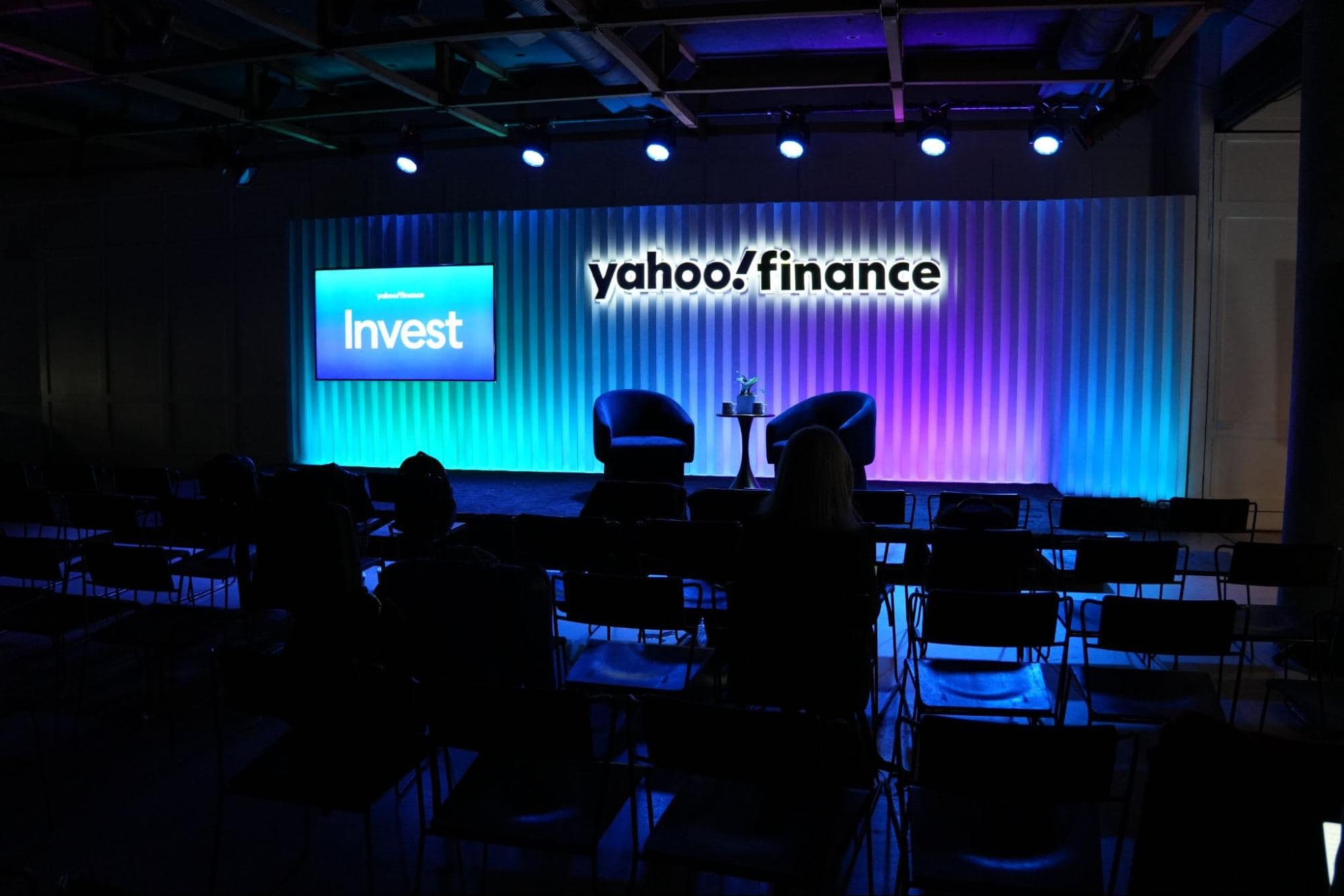
The second annual Yahoo Finance Invest conference in November 2024 brought together an unprecedented lineup of financial heavyweights, revealing the investment community's most pressing concerns. Bank of America CEO Brian Moynihan expressed deep worry about America's $36 trillion national debt, warning that the country has reached its highest debt-to-GDP ratio since World War II. He joined a chorus of speakers advocating for Federal Reserve independence amid political pressures, stating clearly that he has "no desire to join the incoming Trump Administration" in what he views as a dangerous move toward executive branch influence over monetary policy.
Federal Reserve Bank of Minneapolis President Neel Kashkari struck a tone of "cautious optimism," praising the labor market's resilience while reaffirming the Fed's commitment to returning inflation to 2%. His comments contrasted sharply with those of Judy Shelton, former economic advisor to President Trump, who questioned the entire premise of central banking, asking "Should the Fed set the price of capital – 12 people meeting 8 times per year? Or the free market?" Shelton's presence alongside Fed officials demonstrated Yahoo Finance's commitment to presenting diverse economic perspectives, even as she criticized the Fed for transferring power "from the private to the public sector."
Other notable insights came from Rick Rieder, BlackRock's Chief Investment Officer of Global Fixed Income, who surprised attendees by declaring "technicals are crazy good for equities" and noting a market with "no sellers" in hyperbolic terms. Bridgewater Associates Co-CIO Karen Karniol-Tambour provided sophisticated analysis suggesting Trump's policies could be both growth-positive and inflationary, while noting that European productivity "is terrible, as anyone whose 5:01pm email to a European colleague has gone unreturned until the next day can attest."
The $500 Question: User Backlash and Competitive Positioning
Despite reaching record audience numbers and reporting its largest monthly audience ever in early 2024, Yahoo Finance faces significant scrutiny from its most dedicated users. The platform's move to restrict historical data downloads to premium subscribers sparked immediate backlash in the algorithmic trading community. A September 2024 Reddit thread titled "Alternative data source (Yahoo Finance now requires paid membership)" captured the frustration of quantitative traders, with one 60-year-old trader explaining: "As of last night, Yahoo Finance is now charging approximately $500/year to have a Premium membership in order to download historical data. I'm fine doing that if need be, but was wondering if anyone in this community may have alternative methods."
This premiumization strategy comes as Yahoo Finance solidifies its position against traditional competitors. The platform now reaches more viewers than CNBC's pure television audience, with estimates suggesting 10 million monthly "TV" viewers through connected devices compared to CNBC's approximately 100,000 weekly traditional TV viewers. Yahoo Finance's digital dominance represents a fundamental shift in how investors consume financial news, moving from scheduled television programming to on-demand digital content accessible across devices.
What's Next for Yahoo Finance and Your Investment Strategy
As Yahoo Finance continues its premium transformation, investors should expect increased segmentation between free and paid services. The platform's 2023 acquisition of CommonStock signals a move toward social investing features, while partnerships with Morning Brew (which now airs its daily podcast on Yahoo Finance) and expanded video programming indicate a broader content strategy. For Apollo Global Management, the investment thesis appears clear: monetize Yahoo Finance's massive audience through tiered subscriptions while maintaining its free tier as an entry point for new investors.
The critical question for individual investors becomes whether Yahoo Finance's premium tools justify the subscription costs in an increasingly crowded financial information landscape. Free alternatives for basic data remain available, while professional traders may find the $500 annual fee reasonable compared to Bloomberg Terminal's $24,000/year or Refinitiv Eikon's similar pricing. For most retail investors, the free tier combined with insights from Yahoo Finance's conferences—which are often streamed freely—may represent the optimal balance of cost and value.
The Bottom Line: Key Investment Insights from Yahoo Finance's Transformation
Yahoo Finance's evolution from free data portal to premium financial platform reflects broader trends in digital media: the monetization of attention, the premiumization of tools, and the blending of traditional journalism with creator content. For investors, several key takeaways emerge:
First, recognize that free financial data is becoming increasingly scarce as platforms seek to monetize their audiences. Second, the insights from elite conferences like Yahoo Finance Invest provide valuable windows into how institutional investors are thinking about critical issues—particularly the nearly universal concern about national debt expressed by speakers across the political spectrum. Third, consider whether premium tools align with your specific investment approach; occasional traders may find free resources sufficient, while active investors might benefit from enhanced data.
Most importantly, Yahoo Finance's journey demonstrates that the democratization of financial information continues to evolve. What began as making real-time quotes available to all is now becoming about providing institutional-grade tools to individual investors—for a price. As the platform hosts discussions between Fed officials and their critics, between bank CEOs and startup founders, it serves as a microcosm of the broader debates shaping today's investment landscape. For investors navigating these waters, understanding both the tools and the conversations happening on platforms like Yahoo Finance has never been more critical to making informed decisions in an increasingly complex financial world.