
The 2027 Social Security cost-of-living adjustment (COLA) forecast has narrowed to a range of 3.5% to 3.6% after August's inflation data landed, a projection that would deliver the largest annual raise to benefits since 2023. For the roughly 75 million Americans who rely on Social Security and Supplemental Security Income (SSI), the increase would translate to about $70 to $72 more per month on a typical $2,000 benefit — meaningful breathing room after years of more modest adjustments.
But the headline percentage tells only part of the story. The COLA is still a private-sector estimate, not an official announcement, and whatever raise ultimately lands will be offset by Medicare premiums, tax withholding, and the higher grocery, gas, and rent bills that triggered the increase in the first place. For retirees and pre-retirees building a long-term income plan, understanding the mechanics behind the 2027 forecast — and what could still change — matters more than the number itself.
Where the 2027 COLA Forecast Stands Right Now
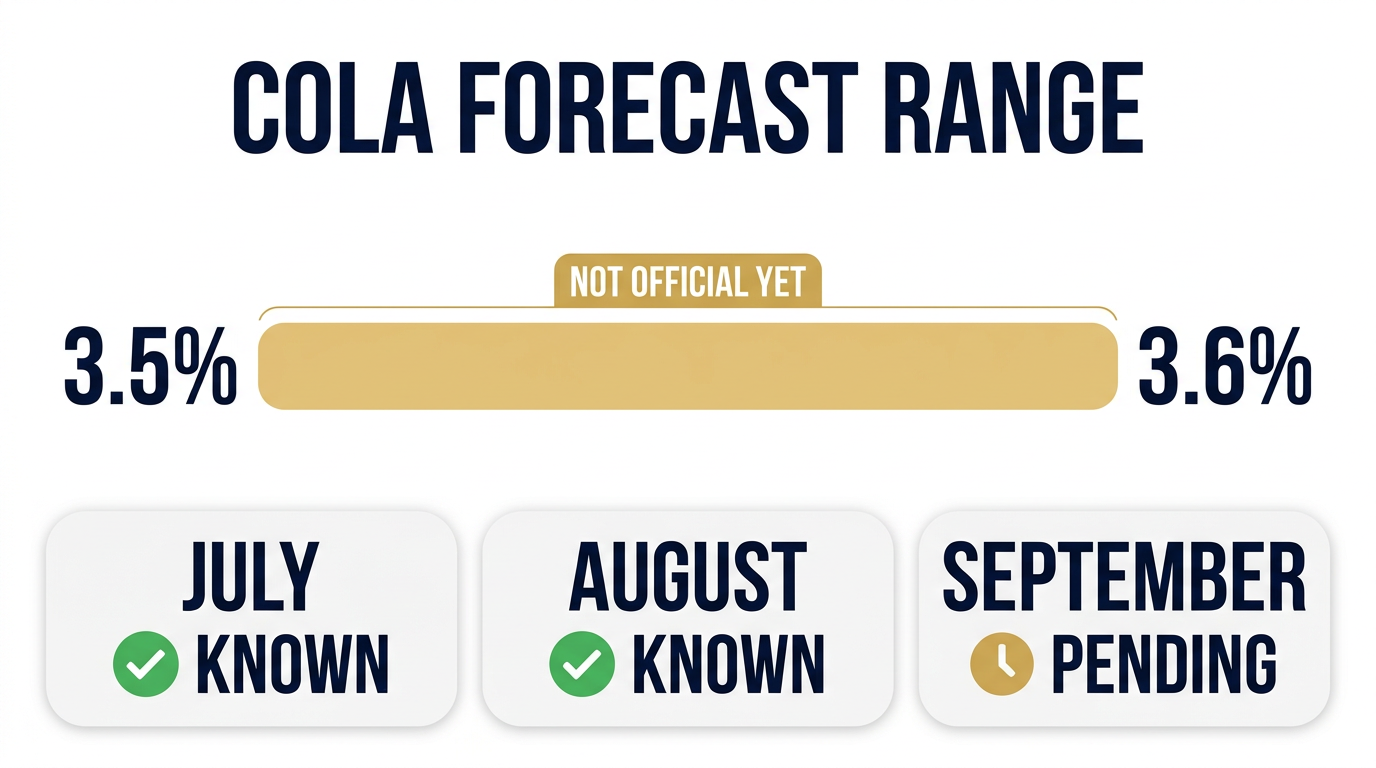
After months of fluctuation, the leading estimates have converged. The Senior Citizens League (TSCL), the nonpartisan seniors group that has tracked the adjustment most closely for years, projects a 3.5% COLA for 2027 — and calls it its final forecast before the official announcement. AARP puts its estimate slightly higher at 3.6%, while a handful of other analysts land near 3.4%. Every one of those figures sits comfortably above the 2.8% COLA currently in effect for 2026.
The adjustment is not set by Congress, the president, or the Social Security commissioner. Federal law ties the COLA to a formula built on the Consumer Price Index for Urban Wage Earners and Clerical Workers (CPI-W). The formula compares the average CPI-W for July, August, and September of the current year with the average for the same three months a year earlier, then rounds the result to the nearest tenth of a percent.
Two of those three months are now locked in. The 2025 third-quarter average was 317.265. July 2026 came in at 327.104, and August at 328.481. Only September remains to be added, and the Bureau of Labor Statistics is scheduled to publish that report on October 14 before the final calculation can be completed.
From 4% to 3.5%: How the Forecast Tightened
The road to the current estimate has been a steady downward drift. As inflation ran hot in the spring, some early projections climbed above 4%. By June, Kiplinger's running forecast had settled at 3.8%, before dipping to 3.6% in July. Just a month ago, estimates ranged from 3.2% to 3.6% — a relatively wide band. Now, with July and August officially in the books, the range has tightened to 3.5%–3.6%.
The August inflation report, released September 11, is what brought the estimates together. The broader CPI-U rose 0.4% for the month and 3.4% over the prior 12 months, while the CPI-W — the index Social Security actually uses — was up 3.5% year over year. Energy was a major driver: gasoline jumped 3.9% in a single month, and the overall energy index climbed 2.1%. Food and shelter kept rising as well. Core inflation, which strips out food and energy, was cooler at 2.4% — but retirees cannot strip gas, groceries, electricity, or rent out of their household budgets.
What a 3.5%–3.6% Raise Adds Up To in Real Dollars
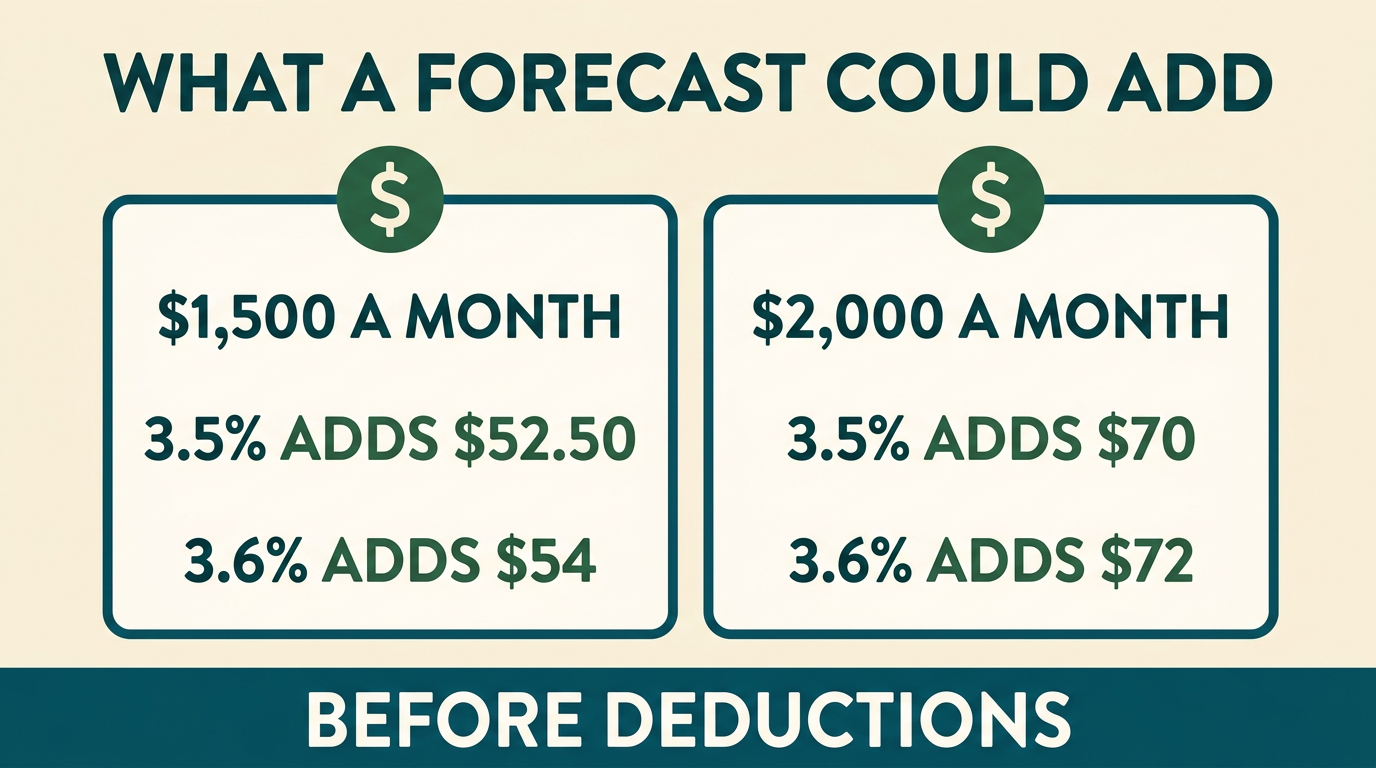
Your starting benefit matters far more than any national average. Multiplying your current gross monthly benefit by the forecast percentage gives a practical planning range. On common benefit levels, a 3.5% COLA versus a 3.6% COLA breaks down like this:
- $1,500 a month: 3.5% adds $52.50; 3.6% adds $54.
- $2,000 a month: 3.5% adds $70; 3.6% adds $72.
- $2,500 a month: 3.5% adds $87.50; 3.6% adds $90.
- $3,000 a month: 3.5% adds $105; 3.6% adds $108.
Those figures are gross estimates before any deductions, and they are planning numbers rather than guaranteed payments. News reports also cite different "average increase" amounts because they start from different baselines. The average retired-worker benefit was about $2,086 in July, while the average across all beneficiaries — including spouses and survivors — was closer to $1,940. Both are correct; they simply describe different groups of people.
The Medicare Wild Card That Can Eat Into Your Raise
For anyone on Medicare, the COLA headline is only the starting point. The standard Part B premium is $202.90 a month in 2026, and the 2026 Medicare Trustees Report estimates $209.50 for 2027 — a $6.60 monthly increase if that projection holds. A beneficiary receiving a roughly $75 gross COLA increase would still keep most of it after that single change, but on a smaller benefit the same premium hike takes a proportionally larger bite.
A safeguard known as the "hold harmless" rule offers some protection. For many people whose Part B premiums are deducted directly from their Social Security payment, the dollar increase in the Part B premium generally cannot exceed the dollar increase in their benefit. The rule does not apply to everyone and does not stop every health cost from rising, but it can prevent a qualifying beneficiary's standard Part B increase from wiping out the entire COLA.
Prescription drug coverage has its own moving parts. CMS has set the 2027 national base beneficiary premium for Part D at $41.33, up from $38.99 in 2026. The standard Part D deductible is scheduled to rise from $615 to $700, and the annual out-of-pocket threshold from $2,100 to $2,400. Those are national figures — actual premiums depend on your plan and location — which is why the Medicare Open Enrollment window from October 15 through December 7 matters as much as the Social Security headline.
When the Official 2027 COLA Will Be Announced
The last piece of the puzzle lands on October 14, 2026, when the Bureau of Labor Statistics publishes September's inflation data. The Social Security Administration normally announces the new COLA as soon as the calculation can be completed, and the increase takes effect with January 2027 benefits. Increased SSI payments typically begin in late December.
Because July and August are already known, a dramatic surprise is less likely than it was earlier in the year — but September still counts for one-third of the calculation. If prices keep climbing, the upper end of the range becomes more likely; if the CPI-W barely moves, the result could settle toward the lower end.
What Retirees Should Do Before Budgeting for 2027
Treating a forecast as spendable income is a common — and costly — mistake. A more disciplined approach treats the 3.5%–3.6% range as a budget update, not a windfall. Financial planners generally suggest a five-step check before committing forecast dollars to anything:
- Start with your own gross benefit, from your benefit notice or my Social Security account, rather than a national average quoted in the news.
- Build a small range by multiplying your benefit by 0.035 and by 0.036 to see the likely increase at each end of the forecast.
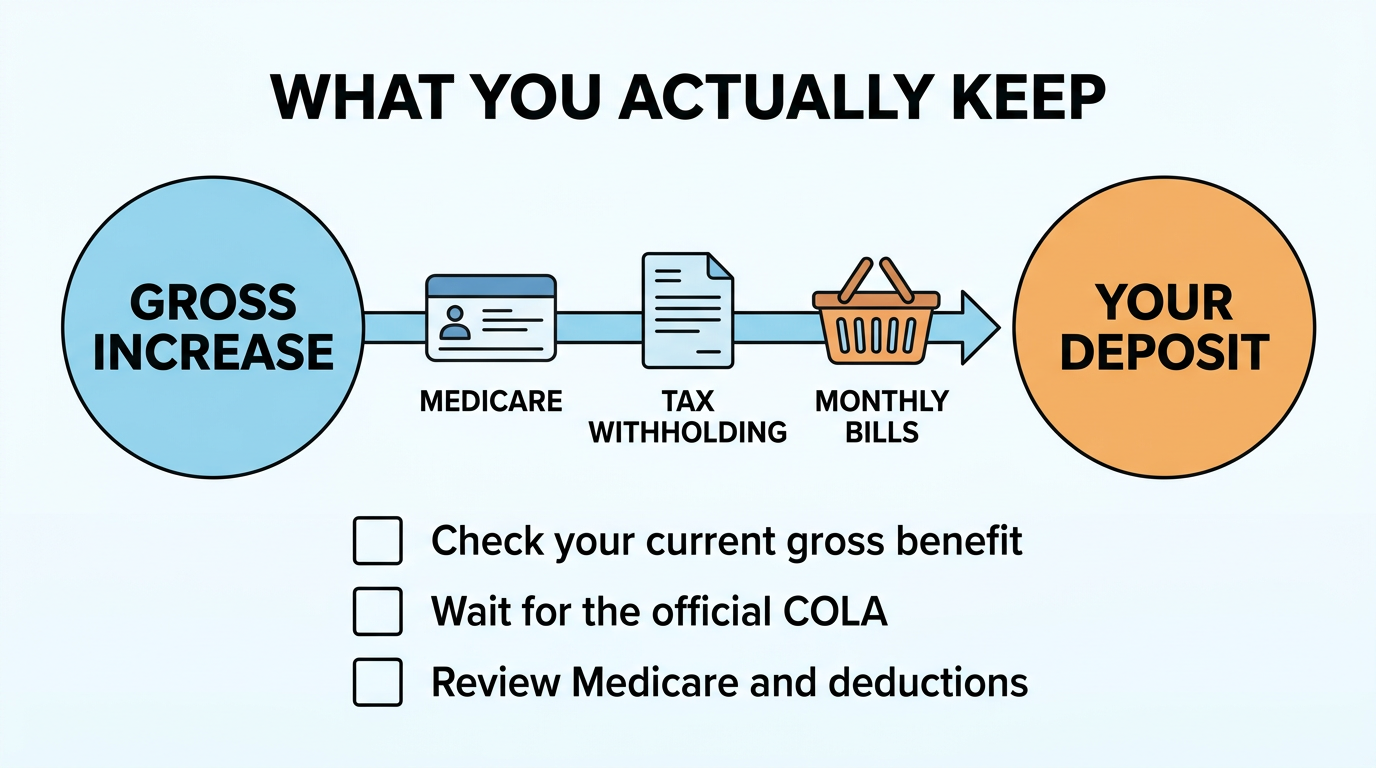
- Review your deductions — Part B premiums, voluntary federal tax withholding, and any Part D premium adjustment.
- Compare gross to net, because the deposit that actually lands in your bank account is what affects your monthly budget.
- Wait for the official numbers before committing the increase to any new recurring expense.
It is also worth remembering that a larger COLA is not a bonus in the usual sense. It exists to help benefits keep pace with prices that have already gone up. If the forecast holds, the 2027 increase would exceed the 2.8% COLA in effect for 2026 — yet remain far below the unusual 8.7% adjustment for 2023 that reflected the post-pandemic inflation surge. A bigger deposit may simply be covering a more expensive month.
The Bottom Line: What the 2027 COLA Forecast Really Means
- The 2027 Social Security COLA is forecast at 3.5% to 3.6%, with The Senior Citizens League at 3.5% and AARP at 3.6%.
- That would be the largest COLA since 2023 and above the 2.8% adjustment in effect for 2026.
- The figure is driven by the CPI-W, with only September's data still outstanding before the official announcement in mid-October.
- On a $2,000 benefit, the raise would add roughly $70 to $72 per month before Medicare premiums and tax withholding.
- The estimated 2027 Part B premium of $209.50 and rising Part D costs will trim the net gain for many retirees.